Disclaimer
I’m not a doctor, not a dietician, I’m a random dude on the internet telling his story of weight-loss, based on some other random dudes’ articles, books and youtube videos. Whatever worked for me may not work for you specifically, even though the things I’ve used seem to work well in general.
Wake-up call
Somewhere in the middle of January 2025 I saw a number on the scales that genuinely scared me. Don’t get me wrong, I’m a big boy, I’m 2 meters tall (~6 ft 6 inches in burger-based measurements), but the quick BMI-scale check told me I was approaching level 2 obesity which did not sound promising to me. I took a look at myself in the mirror and I disliked what I saw there as well. I suddenly felt fat, dissatisfied with my life choices and behavioral patterns and started reflecting on what I could do with that.
Calculate your Body Mass Index using the WHO formula
I’ve been overweight almost all of my life, to a varying degree, since early childhood. I’ve always loved to eat well, enjoying the food in various forms, sometimes indulging in gluttony, accompanied by alcohol. I also have a tendency to use food as a weapon against stress, the same stress that was unfortunately abundant over the last 5 years, binge eating everything in the fridge.
Honestly, I wouldn’t have cared about that before, but January 2025 was a couple of months before my 30th birthday, a point in life where I thought I needed to actually start caring about my body, overall health and the life ahead. I’ve been taking sporadic attempts to lose weight before, with the help of apps like MyFitnessPal and FatSecret, but I got bored quickly and abandoned them. This time was a bit different, the life was on the line, so I needed to do something about it.
I told myself that for half a year I’m going to try conservative methods (dieting and training) and if it does not work - I’ll try out something like Ozempic (spoiler: I did not need it).
Why bother?
Being overweight is wide-spread all across the globe, it’s the new norm with the abundance of food and calorie-dense hyperpalatable foods specifically; body-positivity tells you that you’re wonderful the way you are and you shouldn’t change anything about yourself.
To be honest I hardly ever cared about the way I look and still don’t care about it in the slightest. Having a beer belly and love handles may not look the prettiest, but I’ve programmed myself too much to think that it’s inside that matters in people and myself across the years. What bothers me greatly is the health aspect of being overweight, like, I’d really like to live long, very long, preferably being free of death, if possible, and that stupid human body seems unable to function properly carrying too much fat on it, things start deteriorating.
Excess body fat disrupts insulin signaling, inflames tissues, and overloads the heart. The risk of developing heart disease, diabetes, or stroke increases alongside the BMI rise - more than doubling in overweight individuals and exceeding ten times in severe obesity compared to a healthy weight. Obesity drives cardiovascular disease independently of other risk factors - meaning even if your cholesterol looks fine, the fat itself is doing damage. And it doesn’t stop at the heart: excess weight is linked to at least 13 types of cancer and an elevated risk of death from all causes. The mechanism is straightforward - chronically high insulin levels, persistent inflammation, and disrupted hormones create an environment where cells misbehave.
Basic principles
An analytical little goblin within me can not just get to the point and needs to insert an explanation section, showcasing hows, whys, and whats, so bear with me, I’m a believer that at least a basic understanding of the process is necessary to succeed in something complex like losing weight.
To understand how to gain and lose weight we need to understand, how the human body works with energy, in terms of spending, storing, and obtaining.
Energy spending
Your body does a lot of things like breathing, circulating blood, digesting food, thinking, moving, etc. All these activities require energy, which is provided by the breakdown of macronutrients into ATP. Body’s rate of spending that energy is often referred to as Total Daily Energy Expenditure (TDEE).
Estimate your daily calorie needs using the Mifflin-St Jeor equation
Basal metabolic rate (BMR) - 60-70% of TDEE
Largest consumer of energy, accounting for about 60-70% of TDEE, it is the energy your body needs to perform basic bodily functions at rest (some people call it living).
BMR is primarily determined by lean mass, body size, age, and sex. This is why, for example, losing muscle during a deficit is counterproductive - it shrinks your largest expenditure component. What’s important to note here is the contribution of muscle tissue and fat tissue to BMR, muscles do burn more energy than fat but not to the extent you might think. Muscles burn around ~13 kcal/kg/day and fat burns around ~4.5 kcal/kg/day, meaning that adding 5 kg of muscle (a very substantial amount for a non-steroid user) would increase BMR only by ~65 kcal/day, but muscles contribute greatly to exercise energy expenditure and better hormonal regulation.
Thermic effect of food (TEF) - ~8–15% of TDEE
Digesting, absorbing, and processing food itself costs energy. This varies dramatically by macronutrient: protein costs the most (~20–30% of its caloric content is spent processing it), carbohydrates are moderate (~5–10%), and fat is very cheap to process (~0–3%). This is one reason high-protein diets have a slight metabolic advantage - you “lose” more energy to digestion.
Physical Activity - ~15–30% of TDEE (highly variable)
Has two components on its own: Exercise Activity Thermogenesis (EAT): Deliberate exercise - running, lifting, cycling. For most people who don’t exercise intensely, this is surprisingly small. Non-Exercise Activity Thermogenesis (NEAT): Everything else - fidgeting, walking to the kitchen, maintaining posture, exclaiming MAMMA MIA!. NEAT varies enormously between individuals (by up to 2,000 kcal/day in some studies) and is one of the biggest hidden factors in why some people seem to “eat whatever they want.” High-NEAT individuals unconsciously move far more.
Adaptive thermogenesis (variable*)
This is one of the trickiest things about weight loss - your body wants to maintain the status quo (current weight) regardless of what your frontal cortex tells it. When you diet or exercise vigorously, your body tries to compensate by decreasing NEAT, you unconsciously move less and expend fewer calories than you think. Or you may start craving food more often.
Energy obtaining
Your body is a machine, an efficient one, turning incoming food into energy and storing excess as fat. The food people eat has a lot of stuff in it: micronutrients, macronutrients, fiber, water, alcohol, but we are interested in macronutrients only: carbohydrates, proteins, and fats, as they’re the ones that provide energy to the body. The way these macronutrients are turned into energy is complicated and I will not even pretend to understand it in detail, but, overly simplified, your body breaks these down through digestion (mechanical and enzymatic) into their simplest forms: amino acids, glucose/simple sugars, and fatty acids. These molecules enter your bloodstream and are delivered to cells, where they go through a series of biochemical reactions (glycolysis, the citric acid cycle, oxidative phosphorylation) to produce ATP - the universal energy currency your cells actually “spend.”
Energy storing
Your body has two primary sources to preserve energy: storing excess glycogen in the liver and muscles and storing it as fat. We’re not interested in the first one, we worry about the latter. Fat is stored in our bodies as lipid droplets within adipocytes, primary constituents of the adipose tissue, what we actually call the body fat. I was always thinking about it as being some kind of a ballast within the organism, but it turns out it’s an important organ, producing hormones like leptin, resistin, affecting the reproductive system and the whole metabolism in the process.
I will not even pretend I understand the biology of the processes, but here’s a picture showing how complex the adipose tissue role is from Britannica:
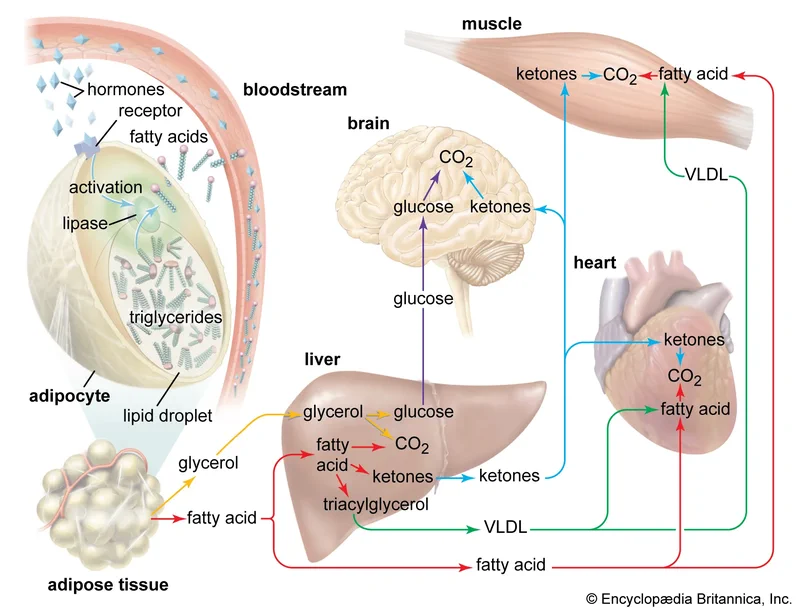
What’s important for the sake of the article is understanding that the prolonged caloric surplus leads to the accumulation of fat, both by increasing the fat cell sizes, and by increasing the total number of fat cells in the body (though it’s a bit more complicated and may depend upon a person’s age and a history of obesity in childhood).
Burning
Most people think fat is "burned" as energy. In reality, you literally breathe it out.
The principle is simple - you need to burn more calories than you consume, it’s called being in a caloric deficit. If you’re in it - your body will start burning away tissue (literally turning it into carbon dioxide you’re breathing out each second), and what you hope for is that it’s the fat tissue that gets burnt more than your muscles.
Cut the crap, what DID YOU DO?
Okay, okay, I got a bit carried away. Let’s talk business, here are the tools that helped me.
Adjusting the mindset
You’ve heard it a myriad of times, but nevertheless it’s an applicable advice: prepare for the marathon, not a sprint. If you need to lose the substantial amount of weight it will take you a substantial amount of time, quarters and years. It’s not like you’re gonna prepare for the summer by only drinking water and spinach smoothies, it’s more like you’re going to change the way you think and behave every single day. You will face ups and downs, your body will actively work against you, there will be terrible mood swings and days when you devour the whole can or two of Ben&Jerry’s Chocolate Fudge Brownie. You need to be calm and understand that it is a consistent set of actions and thoughts that define the results, not single outbreaks.
There also be holidays, team-buildings, birthdays, offsites, days where you won’t be able to meet your calorie-deficit goal. Embrace it, enjoy your time, enjoy your company and enjoy the food, you’re not a machine with the schedule and allowed to have setbacks.
Tracking calories
Disclaimer: not an advertisement
I mean tracking calories every single day. Even when I’m tired. Even when I accidentally drink the whole bottle of wine and devour two or three charcuterie boards feeling an astonishing amount of guilt.

I cannot overstate the importance of understanding how many calories you truly take in on a daily basis, you can not trust your gut feeling about the numbers.
For tracking purposes I use the Lose It! application. It works on both iOS and Android, has a lovely interface and is pleasant to use, compared to MyFitnessPal, for example.

It allows you to measure your current TDEE, set the weight goal and approximate timeline. It will build the calorie schedule per day according to a selected strategy (I use the staircase one, where I have fewer calories on Mon-Thu and more on Fri-Sun), it also has a large database of products and a good UX for tracking, can not but recommend.
Weighing
You should understand that you’re moving in the right direction and you need objective ways to prove that. Scales don’t lie, so I weigh myself every 3-4 days and track the numbers.
You should be prepared for weight swings, especially in the beginning. Remember, it is physically very difficult to lose or gain 1 kg of fat (you need to over-eat by 7500+ kCal to achieve that) or muscle in a day, but you can easily gain or lose 1-3 kilos of water in your body. You should see a downward trend though spanning across weeks and months. Below is my real data exported from the LoseIt! app. As you can see there are scary peaks, lasting a while, but the trend is there. I have plateaued a bit as I’m quitting the nicotine addiction and it makes maintaining a steady caloric deficit difficult, but I hope it will get back to the same rate soon.
Eating below your TDEE
It’s obvious, but you should consume less energy than your body consumes daily, so that it takes the remainder of the energy from your energy stored in fat. If you’re a gluttonous prick like I was, that can be difficult. Below is the simple calculator of how long it will take to get to your target weight given varying caloric deficits:
See how long it takes at different deficit rates
Changing what you eat
To be honest this deserves its own article, as there are lots of aspects to cover. But here’s the gist of what I changed and why.
Eat more lean protein. Protein is your best friend when you’re in a deficit. It’s the most satiating macronutrient by far - you feel full longer after a chicken breast than after a bowl of pasta with the same calorie count. On top of that, remember that thermic effect of food thing from earlier? Your body burns 20-30% of protein calories just digesting it, compared to the measly 0-3% for fat. So 100 kcal of chicken is effectively fewer usable calories than 100 kcal of butter. I set the daily goal of 1g of protein per cm of height and, to be honest I don’t hit this goal as often as I’d like, but I keep my average at ~160g.
Eat voluminous food with low caloric density. I like my belly feeling full. A massive bowl of salad with some grilled chicken is like 350-400 kcal. A single croissant with butter is the same. Guess which one makes you feel like you’ve actually eaten something? Vegetables, fruits, lean meats, soups - these are your allies. You can eat a genuinely absurd amount of cucumbers, tomatoes, broccoli and bell peppers before you hit any meaningful calorie count.
Food schedule does not matter. There’s a whole cult around intermittent fasting and meal timing, and look, if it works for you - great, do it, I gave it a try myself. Personally I prefer having 2 larger meals during the day with light snacks in between. I tried the 6-7 smaller meals approach that every fitness influencer seems to recommend and it just made me feel like I was perpetually eating and never satisfied. Find what keeps you sane and stick to it.
Avoid liquid calories. This was a big one for me. A glass of orange juice? 110 kcal. A latte with milk? 150-200 kcal. A pint of beer? 200+ kcal. A bottle of wine over dinner? 600+ kcal. None of these make you feel full. Not one bit. Your brain barely registers liquid calories as food, so you drink them on top of everything you eat. I switched to black coffee, water, and zero-calorie drinks.
Decrease the amount of highly palatable food. Here’s the uncomfortable truth: the food industry has spent billions engineering products that override your satiety signals. That combination of sugar, fat, and salt in chips, cookies, and fast food is not an accident - it’s designed to make you eat more than you need. I’m not saying never eat a pizza again (I’d rather die), but being aware of how these foods hijack your brain helps you make better choices most of the time.
Avoid fast-food. An extension of the previous point. A Big Mac meal is roughly 1,100 kcal. That’s potentially half of my daily calorie budget gone in 10 minutes, and I’ll be hungry again in two hours. Fast food is the perfect storm of high calorie density, low satiety, and addictive taste engineering. I only eat it in airports or during the long car journeys (both are rare).
Decrease the amount of butter and oil used when cooking. This is boring but effective. A tablespoon of olive oil is ~120 kcal. When you’re frying something and casually pouring oil into the pan without measuring, you can easily add 300-400 kcal to a meal without even noticing. An oil dispenser is a good purchase. I’m not going zero-fat (fat is essential, makes food taste good and keeps your body functioning), but the difference between drowning your vegetables in oil and using a reasonable amount is hundreds of calories a day.
Keep snacks out of close proximity. This is pure psychology. If there’s a bag of chips on my desk, I will eat the bag of chips. Not because I’m hungry, but because it’s there and my lizard brain has zero impulse control. The solution is simple - don’t buy the stuff, don’t keep it at arm’s reach. If I want a snack badly enough to get up, put on shoes, walk to a store and buy it - fine, I probably genuinely want it. But 90% of my snacking was pure convenience-driven autopilot.
Avoid alcohol. I saved the hardest one for last. Pure ethanol is 7 kcal per gram (almost as calorie-dense as fat), provides zero nutritional value, impairs your judgment about food choices, disrupts sleep, and inhibits fat oxidation - meaning your body literally pauses burning fat while it deals with the alcohol. Beyond the calories in the drinks themselves, drunk me has never once said “you know what sounds great right now? A sensible portion of grilled chicken.” It’s always kebabs, pizza, and regret. I didn’t quit drinking entirely, but I cut it down dramatically, and the impact on both my weight loss and general well-being has been enormous.
Resistance training
You will lose muscle in the caloric deficit unless you are training with weights. In the catabolic state your body will burn both fats and muscles and your task is to prove to your body that muscles are viable, used and shouldn’t be broken down, which is done by lifting heavy things across many forms of a resistance training. I go to the gym 2-3 days per week, monitor my progress and try to make my sets close to failure, to get most of the muscle response. I’ll soon do the second DEXA scan and will be able to tell, if I lost or gained the muscle along the way.
Staying active
You gotta move more. Find the activity you enjoy (I like walking and cycling), that keeps your activity level up, and stick with it. I don’t really believe you need heavy cardio sessions in the gym (I hate it, I never do cardio), but rather finding something that brings you joy whilst making you run, jump, jiggle and whatever.
Final thoughts
I stepped on the scale the other day and the number didn’t scare me. That’s new. I looked in the mirror and didn’t hate what I saw. Also new. My bloodwork is better, my energy is better, and I can walk up stairs without sounding like a broken vacuum cleaner.
I expected some dramatic transformation moment — a montage, maybe a slow clap. It didn’t happen. I’m the same person, just lighter. The analytical goblin is satisfied with the data. The lizard brain still wants Ben & Jerry’s sometimes. We negotiate.
There are 10 more kilos to go, more muscle to build, and I’m sure there will be weeks where the scale jumps up and I’ll want to throw it out the window. But it’s been over a year, and the boring, unglamorous stuff worked. No magic pills. Just chicken breast, lifting weights, and not keeping chips on my desk.
Drunk me still votes for kebabs, pizza, and regret. He just gets outvoted more often now.